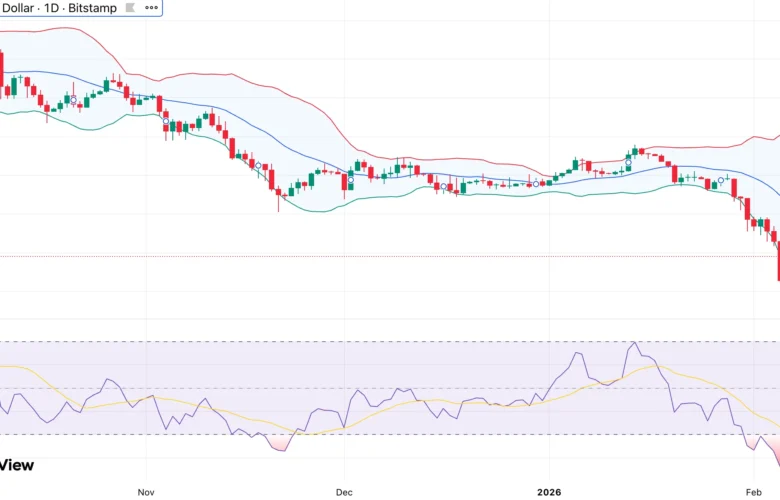
The price is still below the 50-day and 20-day moving averages, which are both limiting attempts at an upward trend. Momentum is still lacking. The relative strength index is in the 32–34 range, indicating an oversold situation without a definite bullish divergence.
After a period of compression, the price is clinging to the lower Bollinger Band as the bands begin to widen. In similar situations, failing to reclaim the mid-band often leads to further downside. Volume patterns reinforce this outlook, showing steady liquidation rather than panic selling, since sell-side spikes are not met with strong rebound activity.
A brief push toward $73,000–75,000 is feasible if Bitcoin can maintain above $68,000–69,000 and recover $71,000. A sustained close above the 50-day average near $79,000 would be needed to shift the trend.
On the downside, failure to defend $68,000 keeps pressure intact. A break below $62,800 opens the door to $60,000, with deeper liquidity waiting near $58,000.
U.S. sentences crypto scam mastermind to 20 years over $73M fraud
A U.S. federal court has sentenced a key figure behind a global cryptocurrency investment scam to 20 years in prison, capping one of the largest crypto-fraud prosecutions tied to so-called “pig butchering” schemes.
The operation defrauded victims of more than $73 million, largely through fake trading platforms and online deception.
Fugitive sentenced in Absentia
The defendant, Daren Li, was sentenced in the Central District of California despite being a fugitive at the time of sentencing. Li, a dual citizen of China and St. Kitts and Nevis, removed his electronic ankle monitor and fled U.S. supervision in late 2025.
U.S. authorities said efforts are ongoing to locate and return him to serve the sentence.
Li had pleaded guilty in November 2024 to conspiracy to commit money laundering, acknowledging his role in moving fraud proceeds generated by overseas scam centers operating primarily out of Cambodia.
Inside the $73 million crypto scam
According to prosecutors, the scam relied on unsolicited social media outreach, fake cryptocurrency investment platforms, and spoofed websites designed to mimic legitimate trading services.
Victims were gradually manipulated into sending funds after building trust through fabricated personal or professional relationships.
Once funds were obtained, Li and his co-conspirators funnelled the money through shell companies and U.S. bank accounts before converting it into cryptocurrency. At least $59.8 million in victim funds passed through U.S.-based accounts as part of the laundering operation.
Eight co-conspirators have already pleaded guilty in related cases. The Justice Department said Li is the first individual directly involved in receiving stolen proceeds to be sentenced, highlighting a broader push to dismantle international crypto fraud networks and hold organizers accountable.